 By Fely Santiago, PTRP
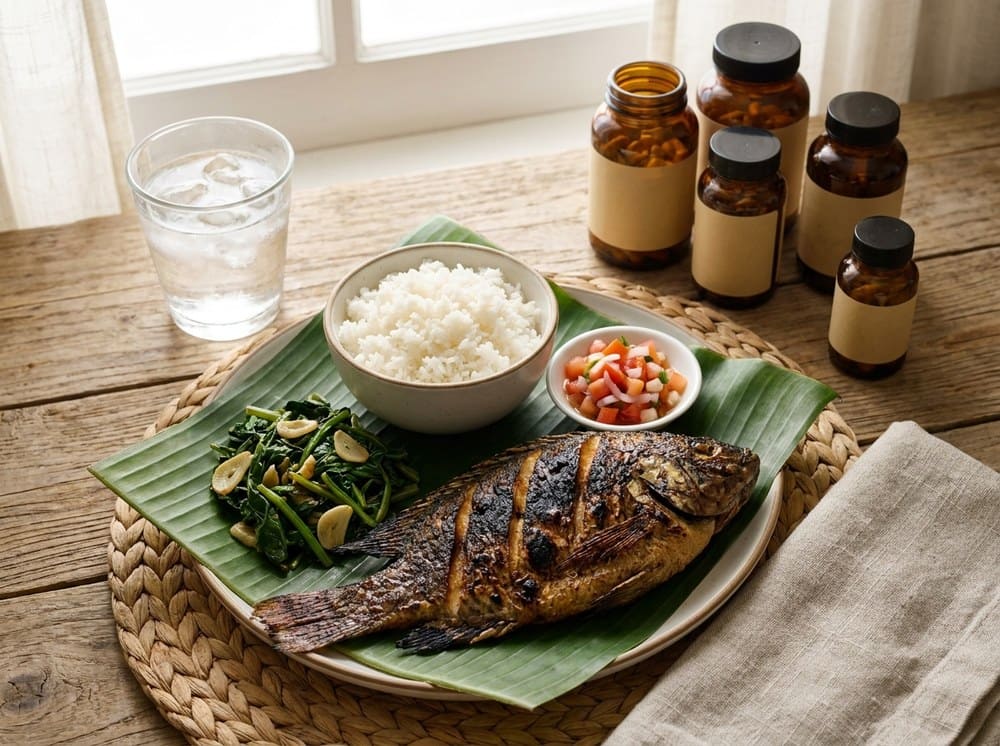
"Doc, okay ba itong kinukuha kong glucosamine? Kasi ang mahal, pero sabi ng kapitbahay ko effective." I hear this weekly. The joint supplement industry is enormous — ₱800 here for glucosamine, ₱1,500 there for collagen, another ₱1,200 for fish oil, plus maybe MSM and turmeric capsules thrown in for good measure. That is easily ₱4,000 to ₱6,000 a month going into bottles. For some patients, this is money well spent. For most, it is money that would build more function if directed somewhere else. This article walks through what the evidence actually says — honestly — and where physiotherapy fits into the picture.
How to read supplement research (the short version)
Supplement studies are messy. Doses vary, duration varies, product quality varies (an unregulated ₱300 bottle at a sari-sari store is not the same molecule as a pharmaceutical-grade version used in clinical trials). When you see "proven effective," always ask: proven in whom, at what dose, for how long, and compared to what?
The framework I use when patients ask me about supplements:
- Strong evidence: Multiple high-quality randomized controlled trials showing consistent benefit.
- Moderate evidence: Mixed studies, some showing benefit, some not — usually in specific subgroups.
- Weak evidence: Small studies or reviews that cannot clearly separate effect from placebo.
- Basically placebo: No credible human evidence of benefit at usual doses.
Now the honest breakdown of the big four supplements Filipinos buy for their joints.
Glucosamine (with or without chondroitin)
Verdict: Moderate evidence for specific cases, weak to none for most.
Glucosamine is a naturally occurring sugar involved in cartilage building. The idea that eating more would rebuild cartilage is intuitive — and mostly wrong. Your digestive system breaks it down before it reaches any joint. Large, well-designed trials (GAIT trial in the US, and European equivalents) showed no meaningful improvement over placebo for mild OA, and modest benefit for a subgroup with moderate knee OA when combined with chondroitin — at pharmaceutical-grade doses (glucosamine sulfate, 1,500 mg daily), taken for at least 8–12 weeks.
Who might benefit: People with moderate (not mild, not severe) knee OA, willing to commit to 3 months at the proper dose and form. Even then, the effect is usually small.
Who should not bother: People with early joint discomfort, mild stiffness, or joint pain from non-OA causes (tendinitis, bursitis, muscle imbalance).
Collagen (hydrolyzed, Type II)
Verdict: Weak to moderate evidence; useful for some, hype for many.
Collagen has become the darling of the Manila wellness scene — powders in smoothies, capsules before bed, drinks marketed to women in their 40s. The research is genuinely interesting for undenatured Type II collagen at specific doses (40 mg daily) for joint pain, but the commercial products sold in supermarkets are usually hydrolyzed collagen at much higher doses for skin — a different formulation with weaker joint evidence.
The problem: digestion breaks collagen down into amino acids, which your body then uses wherever it wants. There is no mechanism to send them specifically to your knee.
Who might benefit: People who take it consistently for 3+ months, use Type II undenatured formulations, and have mild joint complaints. Expect a small effect — not a cure.
Fish oil (omega-3 fatty acids)
Verdict: Moderate to strong evidence for inflammatory arthritis; weak for osteoarthritis.
This one is different from the others — fish oil has a real, measurable anti-inflammatory effect at adequate doses (usually 2–3 grams of combined EPA and DHA daily). For rheumatoid arthritis, fish oil can reduce morning stiffness and flare intensity enough that some patients need less medication. For osteoarthritis, the benefit is smaller and less consistent.
Fish oil is also good for cardiovascular health, brain function, and eye health — so even if the joint benefit is modest, there is broader value. If I were going to recommend one supplement to a patient with mild joint concerns and no specific diagnosis, this would be it.
Practical note: Quality matters a lot. Cheap oils oxidize and can do more harm than good. Look for third-party tested brands (USP, IFOS certification).
MSM (methylsulfonylmethane)
Verdict: Weak evidence. Probably mild benefit at most.
MSM is a sulfur compound often bundled into multi-ingredient joint supplements. Small studies show modest pain reduction in knee OA, but effect sizes are small and trials are generally lower quality. It is not dangerous at normal doses — it is just rarely the reason someone's joints feel better when it is buried in a ₱2,000/month stack.
The uncomfortable truth: if supplements were as effective as marketing claims suggest, the physiotherapy waiting list in Makati would be empty. It is not.
What physiotherapy offers that supplements cannot
Physiotherapy is boring compared to supplements. No fancy packaging, no celebrity endorsements. What it has is a 40-year body of research showing consistent, meaningful improvements in function, pain, and quality of life for the major joint conditions. Specifically:
- Manual therapy reduces pain and improves range of motion in knee and hip OA — proven in multiple systematic reviews.
- Progressive exercise matches or exceeds NSAIDs for moderate knee OA symptoms, with no gastrointestinal side effects.
- Weight management support combined with exercise slows OA progression and may delay joint replacement surgery by years.
- Education and activity modification teaches patients why their pain happens — which means they can prevent it, not just react to it.
The thing people miss: supplements, at best, affect the chemistry of the joint. Physiotherapy changes the mechanics and the muscles around it. For most joint pain, the mechanics matter more. Our guide on when to see a physiotherapist rather than just your GP breaks this down further.
When I tell patients "yes, try the supplement"
I am not anti-supplement. I tell patients to try them in these specific situations:
Fish oil for anyone over 40 who does not eat fatty fish twice a week. The broader benefits justify the cost.
Glucosamine sulfate (pharmaceutical grade) for moderate knee OA in a patient already doing physiotherapy, as a 3-month trial. If there is noticeable benefit, continue. If not, drop it.
Vitamin D for most older Filipinos. Despite the sunshine, our urban lifestyle means many adults in Makati are vitamin D deficient. Low D is linked to higher joint pain and faster OA progression.
Notice what is not on this list: the expensive proprietary blends with 14 ingredients marketed as "joint super-complex." Those are almost always overpriced and underdosed for the ingredients that might actually help.
Tip from our team
Before spending ₱5,000 a month on supplements, spend it on two physiotherapy sessions. Do a 4-week home program exactly as prescribed. If pain is not better after that, the supplement money is more likely to help. If it is better, save the ₱5,000 and keep doing the exercise. This is what we call the "physio-first" test, and it is saved a lot of our Makati patients from years of wasteful spending.
The math most patients never do
A monthly supplement stack at ₱5,000 adds up to ₱60,000 a year. A 10-session physiotherapy package at MotionPath is ₱11,500. Even if you repeat the package twice a year (most patients do not need to), that is ₱23,000 — and you come out with stronger muscles, better movement patterns, and skills you keep for life. The supplements stop working the moment you stop buying them. Physiotherapy is front-loaded work with lasting results.
I am not saying throw out your glucosamine. I am saying think about your joint health budget the way you would think about any investment — where does the money produce the most lasting benefit?
The sensible protocol for most people
Here is what I recommend to most Filipinos in their 40s and 50s with early joint complaints:
- Start with an honest physiotherapy assessment to identify what is actually driving the pain
- Commit to a 4 to 8 week exercise program (see our home knee exercises for a starting point)
- Add fish oil (2–3 g EPA+DHA daily, quality brand) as a low-risk anti-inflammatory
- Check vitamin D with your GP; supplement if low
- Consider glucosamine sulfate only for confirmed moderate knee OA, as a 3-month trial
- Skip collagen, MSM, and proprietary blends unless you have money and curiosity to burn
Joint health in Manila's climate — humid, active, jeepney-commuted — is not something a bottle will fix. But a few minutes of the right movement, done most days, combined with targeted professional care when you need it, absolutely can. If you want to talk through your specific situation, including what supplements (if any) make sense for you, come in for an assessment. Our knee and arthritis care program is where most of these honest conversations happen.